
ESG
Sustainability management
[GOV-1] Go to About the Group / Management Board.
Responsibility for managing impacts, risks and opportunities
[GOV-2] ESG, sustainability and impact management are integrated into the Group’s business strategy and its objectives for 2022-2026. The process of managing risks, impacts and opportunities is the responsibility of: Management Board, Supervisory Board and General Meeting. The scope of these bodies’ responsibilities and approach to risks are defined by two documents: The Corporate Risk Management Procedure in the PGE EC Group and the Corporate Risk Management Policy in the PGE Group.
The Management Board is informed about significant impacts, risks and opportunities as well as the results and effectiveness of the policies and actions adopted to implement them, among others during weekly meetings of the Management Board, meetings of the Supervisory Board and meetings of the Audit Committee. The Board is also informed about the effectiveness of sustainability metrics and targets.
ESG matters are raised at meetings of management bodies. As part of its supervisory activities, the Supervisory Board of KOGENERACJA S.A. performs, among others, tasks related to monitoring the degree of implementation of the Business Strategy of KOGENERACJA Group, including the targets related to sustainable development.
The Reporting and Investor Relations Department works closely with the Management Board in the area of corporate communications regarding sustainable development, as well as relations with shareholders and stakeholders. On 3 January 2024, by virtue of the Ordinance of the Managing Director of KOGENERACJA S.A., an ESG Team was established at KOGENERACJA S.A. Its task is, among other things, to prepare the Sustainability Statement, which will be part of the Management Report starting from the report for 2024, in accordance with the ESRS sustainability standards and the CSRD.
Integration of sustainability-related performance in incentive schemes
[GOV-3] The principles regarding the determination of the remuneration of the Members of the Management Board and the Supervisory Board adopted in the Remuneration Policy of the Members of the Management Board and the Supervisory Board of the Company should contribute to the implementation of the Business Strategy, including the concept of sustainable development, long-term interests and stability of the Group companies. In each case, they should be interpreted taking into account the objectives pursued in the process of applying these principles by all bodies of the Company.
The total remuneration of Management Board Members consists of a fixed part (basic monthly salary) and a variable part (supplementary remuneration). Due to the important role of incentive schemes in achieving sustainable development goals, the Remuneration Policy for Members of the Management Board and Supervisory Board of the Company was updated by Resolution No. 25/2024 of the General Meeting. The changes introduced in relation to the previous regulations in force concern linking sustainable development matters with the incentive scheme and the shaping of the variable remuneration of Management Board Members.
The criteria for awarding variable components refer to taking into account social interests, the Company's contribution to environmental protection and taking actions aimed at preventing and eliminating the negative social effects of the Company's activities, in particular through modernisation, taking into account the objectives corresponding to the idea of sustainable development.
The variable component of the remuneration of members of the Management Board and senior management depends on the degree of achievement of the annually set group goals (applicable to the entire Management Board) and individual goals, including goals closely related to sustainable development.
The management objectives set for the members of the Management Board for 2024 and approved by the Supervisory Board resolution 34/1010/2024 on 29 May 2024, include sustainability goals, which account for 67% of the variable remuneration.
These objectives address matters such as:
The management objectives did not include a direct reference to the reduction of absolute levels of greenhouse gas emissions by 2024, however the implementation of the Decarbonisation Plan, including the construction of EC Czechnica (objective 1) and the Wrocław Investment Project (objective 2) will lead to a reduction of CO2 emissions in the following years.
The remuneration structure of persons serving as Members of the Supervisory Board of the Company consists exclusively of fixed remuneration.
Risk management and internal controls over sustainability reporting
[GOV-5] Risk management matters are described in detail in the Corporate Risk Management Policy in the PGE Group adopted by the Group in 2022. In addition, solutions in the field of integrated risk management architecture have been implemented - specified in the Procedure - Model of an integrated management system in the PGE EC Group. The primary goals of the process in the currently used model are to:
The measurement of risks related to current operations is performed in a given year with a perspective of the previous year. In this way it is possible to identify and prepare an appropriate response to risks in the context of significant changes taking place in the Group’s key functions.
Risks are assessed and analysed in key areas of the Group's business activities. Mechanisms for identifying areas at risk and methods of measuring risk levels are subject to constant verification and improvement. In this way, significant risks related to individual business functions are kept within established limits, and relevant mitigating, preventive and corrective measures are taken as and when needed.
ESG risk assessment is a separate process from the corporate risk management process, but they complement each other in terms of data sources for their implementation. Each risk was assessed in terms of its probability of occurrence and financial impact on a scale of 1 to 5 in three time perspectives: short, medium and long term. The way in which risk is dealt with depends on the value of the risk.
The Group has identified significant risks relating to sustainability reporting and has taken actions to mitigate them:
Data verification was carried out at individual levels of responsibility. Data were compared for completeness and data were analysed with reference to previous years to the extent possible for comparison.
Due to changing legal regulations and reporting requirements that may affect the reporting method, the Group actively monitored legal changes in the ESG area. It also used the services of an Advisor in legally uncertain matters.
Adjustments to ESRS requirements were related to the costs of employing an ESG specialist, costs of additional training, costs of the Advisor’s support services and attestation costs. The funds were secured in the Company’s budget for 2024.
In 2024, the Group conducted internal training in cooperation with the Advisor for persons responsible for individual elements of sustainability reporting. Persons responsible for reporting participated in postgraduate studies and dedicated training.
The risk management process and internal control over sustainability reporting takes place within the framework of existing business and financial methods and processes. Constant supervision over the risk management process in all areas is the responsibility of the Management Boards of the companies included in the Group.
Strategy, business model and value chain
Strategy
[SBM-1] The Management Board is responsible for the Group's strategy and business model, acting in close consultation with the Supervisory Board, and the issues specified in the Company's Articles of Association are submitted to the General Meeting for assessment.
On 6 October 2022, the Supervisory Board of KOGENERACJA S.A., at the request of the Management Board, adopted the Business Strategy for 2022-2026 of KOGENERACJA Group, which includes, among others, matters related to sustainable development. This is the Group's response to the changing economic, geopolitical and social environment as well as changing environmental trends and needs.
KOGENERACJA S.A. and its subsidiary EC Zielona Góra S.A., leaders in sustainable district heating on local markets, implement the mission and vision of the PGE Group and its Strategy aimed at decarbonising generation and climate neutrality by 2050.
The vision of KOGENERACJA Group translates into three strategic priorities, which include:
KOGENERACJA Group declares that it will reduce its impact on the natural environment by achieving climate neutrality in 2050. A permanent reduction in emissions is planned by changing the production technology and moving away from the use of hard coal to other, more environmentally friendly fuels. By 2030, the share of low-emission sources in the generation portfolio will be 100%.
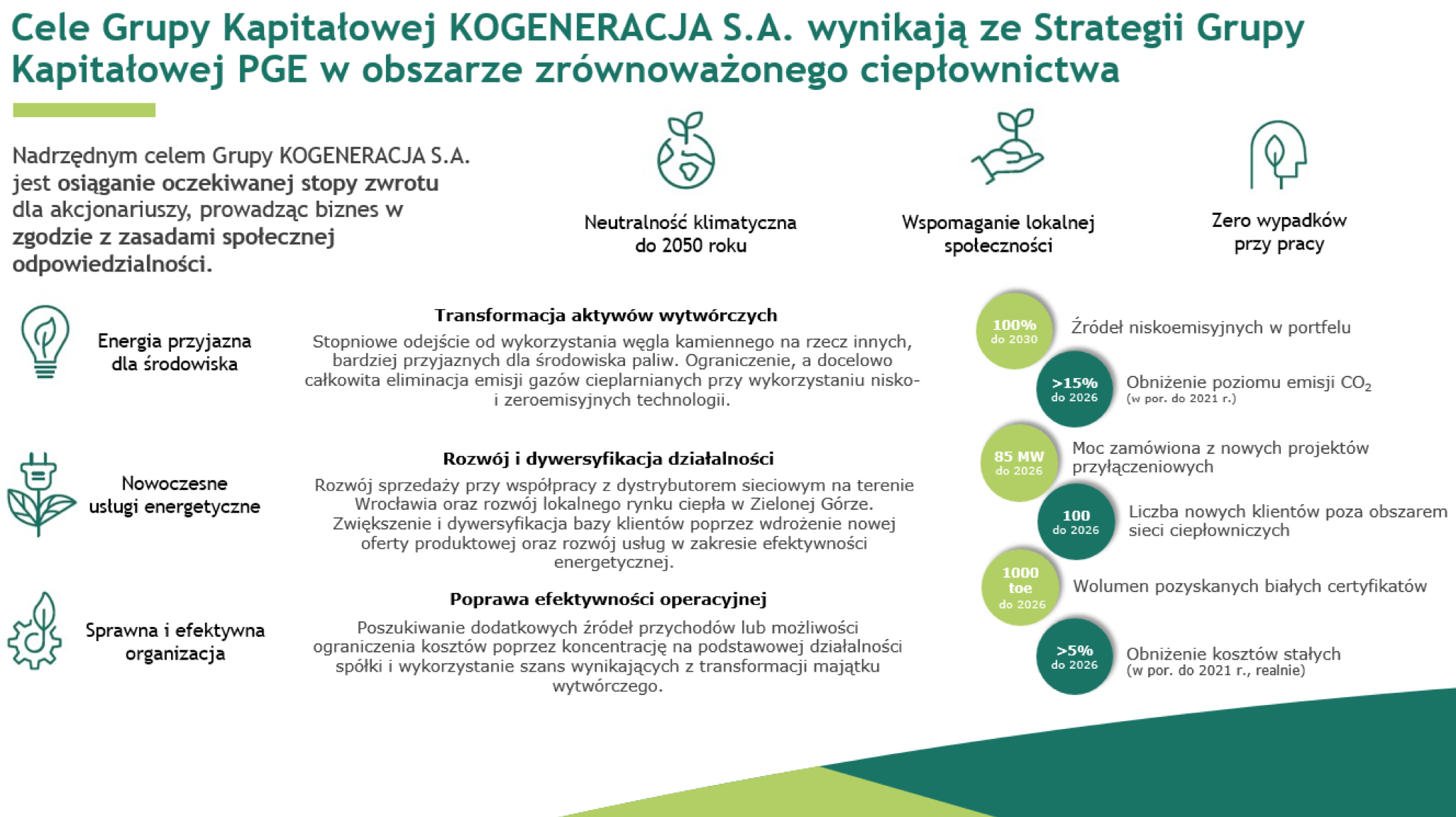
By 2026, the Group plans to reduce CO2 emissions by 15% (compared to the 2021 emission level of 2 155 792 Mg CO2), and ultimately to completely eliminate greenhouse gas emissions using low and zero emission technologies.
Stimulating the transformation and development of heating and contributing to the improvement of the quality of the environment in accordance with the Strategy will be carried out in accordance with the principles of corporate social responsibility through:
By implementing the Business Strategy for 2022–2026, KOGENERACJA Group supports the 7 UN Sustainable Development Goals:
Transformation of production assets


Transformation of production assets


Development and diversification of activities
Conducting business in accordance with the principles of corporate social responsibility

Business model
[SBM-1] Zespół Elektrociepłowni Wrocławskich KOGENERACJA SA consists of three production plants with a total electrical capacity of 310 MWe and heating capacity of 1 064 MWt. KOGENERACJA SA is a producer of network heat and electricity, mainly through cogeneration.
As a producer of heat for Wrocław and its surroundings, the Company caters to demand for heating, domestic hot water and technological heat. It also produces electricity as par of the national power system. Heat and electricity are produced in co-generation, which ensures that the average yearly production capacity is high and the chemical energy of primary fuels is the most effective in the sector. Network heat and electricity are primarily produced using natural gas, hard coal and biomass.
EC Zielona Góra SA is a commercial power company producing heat and electricity in a combined system. The company produces electricity through cogeneration in the CC Gas Unit with an installed capacity of 198 MWe. It owns a heating network and is a distributor of heat.
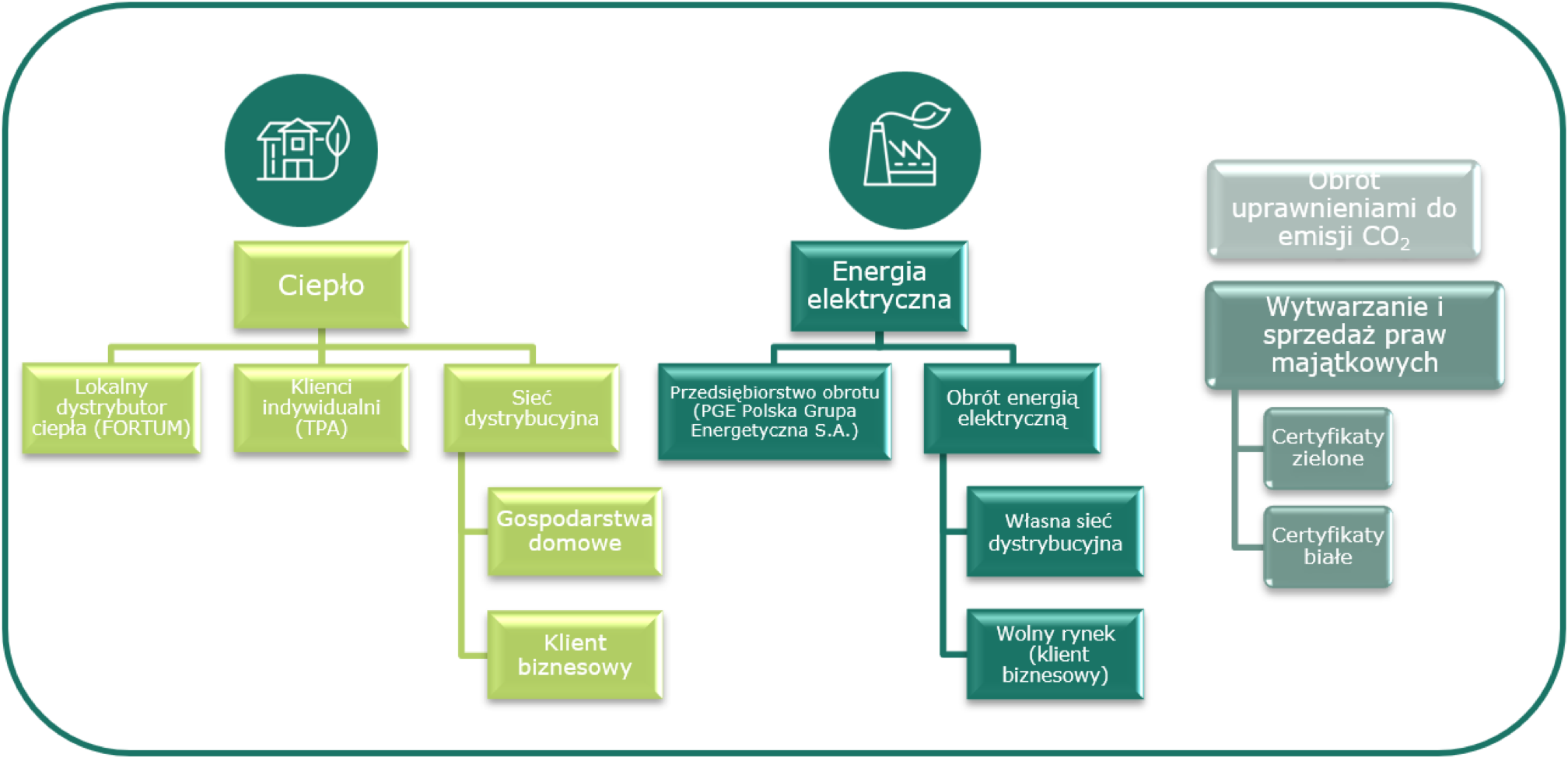
Production, sale and distribution of heat
Heat is the main product produced in the combined system at KOGENERACJA SA. It is sold to local customers (Wrocław, Siechnice) in the form of hot water. The price of heat is regulated (tariffs for heat are subject to approval by the President of the Energy Regulatory Authority (ERA)). The wholesale buyer of heat is the distribution company Fortum Power and Heat Polska Sp. z o.o. Heat is also sold directly to individual customers. The company distributes heat through its own network in the municipality of Siechnice.
EC Zielona Góra S.A. also produces heat in a combined system. Over 90% of the heat is generated in the CC Gas Unit fueled by natural gas from domestic deposits. The remaining heat is produced in modern gas-oil boilers, where gas is the basic fuel. Additionally, it is the owner of the heating network and the distributor of heat. It is the only source of heat for the heating system in Zielona Góra for the purpose of heating and domestic hot water (EC Zielona Góra S.A. is an owner of this system).
The share of EC Zielona Góra S.A. in the heat market in Zielona Góra is 47%. EC Zielona Góra has approximately 140 km of heating networks, of which 105 km, or 75%, are pre-insulated networks constructed using modern technology, characterised by low heat losses. The company has 7 local gas boiler plants, which will be gradually connected to the heating network over the subsequent years.
Production and sale of property rights
KOGENERACJA S.A. obtains certificates of origin mainly by producing green energy from the co-firing of biomass (green certificates). Certificates are traded through PGE S.A. The companies are required to redeem certificates due to the sale of electricity to end buyers also through PGE S.A.
Trading in CO2 emission allowances
The Group purchases and sells CO2 emission allowances through PGE S.A. The companies independently redeem CO2 emission allowances in keeping with the actual emissions.
Value chain
[SBM-1] Due to its activities involving the production, distribution and sale of district heating and electricity, KOGENERACJA Group belongs to the sector: Energy production and energy services in the macro-sector: Utilities.
Based on the implementation guidelines for the European Directive on Corporate Sustainability Reporting (CSRD), as part of the defined double materiality analysis process, the value chain of KOGENERACJA Group and its exposure to ESG factors at various stages have been mapped.

The entities in the value chain come from Poland. Based on the results of the sector classification, a value chain mapping tool was prepared for the Group, covering activities in the heat and energy production sector, taking into account the following elements: value chain stage (activity), entity, sector/industry, geographical environment and regulatory environment. The task was discussed in a workshop with representatives of KOGENERACJA S.A., who completed the tool in the next step. Based on data and ratings provided by the World Bank and the International Labour Organization (ILOSTAT), an analysis of risks occurring in the value chain related to the areas of environmental, social and corporate governance was carried out. Data concerning Poland were analysed.
Based on the risk analysis conducted, the following topics were identified as important from the value chain perspective:
The results of the value chain analysis were used in the next stage of the work (impact significance analysis and financial significance analysis) as a complement to the survey methods to determine the level of materiality.
Material impacts, risks and opportunities
[SBM-3] The impacts, risks and opportunities of KOGENERACJA Group. were identified as a result of the double significance analysis conducted in 2024. The materiality assessment included a comprehensive examination of the impact on the Group companies’ environment, as well as checking whether a given impact is actual (currently occurring), potential (may occur in the future), positive or negative and how it may change in the future.
Impacts were assessed taking into account timing, scale, scope, reversibility and likelihood of occurrence, and were addressed over the short, medium and long term. The analysis of climate risks was not supported by an analysis of the resilience of the business model.
Interests and views of stakeholders
[SBM-2] Based on the guidelines of the European Corporate Sustainability Reporting Directive (CSRD), a stakeholder dialogue was conducted within the defined double-materiality analysis process. This part of the double materiality analysis focused on gaining insight from KOGENERACJA S.A. stakeholders on how they perceive the organization's impact on various ESRS subtopics within ESG. The dialogue with internal and external stakeholders consisted of a survey and interviews with stakeholders. The survey design was based on the topics and subtopics of ESRS across all ESG areas, taking into account the assessment of both positive and negative impacts.
To create the stakeholder map, a list of stakeholders was built and then assessed within the organisation in terms of impact and interest on a scale of 1 to 30. The results were integrated and analysed to identify key stakeholder groups.
The stakeholder groups that assessed the impact included:
Interviews with employees of KOGENERACJA Group made it possible to deepen knowledge about the organisation, its significant impacts, risks and opportunities related to ESG. The survey also allowed participants to submit any additional comments and topics in an open-ended question. As a result of the materiality assessment, 16 stakeholder groups were identified
Key stakeholders of the Group | Scope of cooperation, communication and goals |
|---|---|
1. Shareholders | PGE Energia Ciepła S.A. (58.07%) and the ultimate parent company PGE Polska Grupa Energetyczna S.A. Minority shareholders include pension funds, domestic and foreign investment funds, as well as corporate and individual investors. An important subgroup includes stock market and ESG analysts, brokerage houses, potential investors, the Association of Individual Investors, the Stock Exchange and the National Depository for Securities (KDPW) The Reporting and Investor Relations Department coordinates all activities necessary to initiate and maintain good relationships with current and potential shareholders and investors. This means comprehensive and timely communication with the market and adherence to the highest reporting standards. Objective: Creating a transparent information policy and strengthening the sense of partnership and trust between the Company and its investors, informing about financial and operational results, increasing the Company's capitalization. |
| 2. Strategic clients | The main strategic clients are:
Objective: Building lasting, mutually beneficial relationships between Group companies and the customer, understanding specific needs and expectations, jointly developing products and services, optimising processes and efficiency, strengthening cooperation in the field of innovation and growth. |
| 3. Climate and environment | The Group communicates its impact on the natural environment, including through reports sent to public administration units dedicated to environmental protection, through the publication of non-financial information in annual reports and information on the website. Objective: Increasing information about the Group in the field of sustainable development, raising awareness of environmental protection, promoting sustainable practices and engaging stakeholders. |
| 4. Central and local authorities | The Group is involved in cooperation with public authorities and maintains regular dialogue with local government, provincial and central administration. Objective: Cooperation in the development of the region, building an image that supports the development of the Group's activities, cooperation in the implementation of social and infrastructure projects, as well as building and maintaining lasting contact between the Group and its public environment. |
| 5. Trade unions and employee organisations | There are currently 9 trade union organisations operating within KOGENERACJA Group, with which the Management Boards of both companies conduct regular dialogue. Company trade unions co‑shape the organisation’s personnel policy by conveying the opinions of employees on remuneration and social policy, working conditions, benefits, employee development opportunities and the development of the Group. Objective: Maintaining a balance between the interests of the employer and the rights of employees, building a lasting social dialogue, preparing and adapting to changes related to sustainable development. |
| 6. Employees | Employees create the Group's organisational culture and, thanks to their experience and high qualifications, they influence the implementation of the organisation's strategic goals. They contribute to ensuring safe supplies of heat, hot water and electricity in the region. It is crucial for KOGENERACJA Group to create safe working conditions and stable employment for employees. The Group treats open and regular social dialogue as an integral part of its business activities. The Employees group includes: full-time employees, retired employees, and potential employees. Objective: Ensuring effective exchange of information, informing about goals and strategy, maintaining an atmosphere of understanding and a sense of influence on the Group's activities, collecting opinions, managing change, building commitment and motivation, supporting development and education. |
| 7. Contractors and suppliers | Contractors and subcontractors are entities implementing key development investments and entities supporting the implementation of technological and supporting processes. Suppliers, according to the supply chain, are mainly suppliers of coal, gas, biomass, chemicals. The Group’s purchasing policy and the Code of Conduct for Business Partners of PGE Group Companies emphasise compliance with high ethical, social and environmental standards by current and potential suppliers. Objective: Co-creating business standards – conducting business in a responsible and sustainable manner, ensuring the effectiveness of the organisation and getting to know expectations, understanding the needs of suppliers and contractors, jointly addressing innovative challenges. |
| 8. Financial institutions | KOGENERACJA Group maintains an open dialogue with financial institutions: banks, brokerage houses, insurers, other financing institutions (e.g. NFOŚ, WFOŚ), which provide financing for current operations and strategic investments. The Group as a borrower is a trusted business partner that settles its financial obligations within the set deadlines. Objective: Ensuring transparency and compliance with regulations, facilitating access to financial products, optimising financial decisions, maintaining financial stability. |
| 9. Competition | In the process of dialogue with competitors, KOGENERACJA Group is guided by respect for the rules of fair competition, in accordance with the Code of Ethics of the PGE Group. Objective: Fostering market development, cooperating in areas that can bring benefits to both parties, negotiating terms of cooperation, sharing experiences, maintaining high standards in the industry. |
| 10. Institutional partners | The Institutional Partners group includes: government offices: Energy Market Agency (ARE), Social Insurance Institution (ZUS), Statistics Poland (GUS), and state services: fire brigade, police, military. Objective: Reporting activities, correct implementation of legal requirements, ensuring management of environmental impact, ensuring safety. |
| 11. Local communities | The investment processes of KOGENERACJA Group are preceded by a dialogue with local communities in order to provide them with full information on the activities carried out, as well as to learn about and meet social expectations. This group also includes city residents who are often our customers, with whom we conduct joint social initiatives, e.g. educational picnics. Objective: Maintaining harmony and positive relations in the community, supporting the development of the region, active participation in local life, collecting information about social needs, building trust in the organisation's activities in improving the quality of life of local communities. |
| 12. Media | It is one of the key channels of communication with stakeholders for the Group, through which it provides the public with information about its strategy and goals, key events, investments, achievements and financial results. The media also shape opinions about the Group. Objective: Promoting the Group and its values in society, proper understanding of the changes taking place in the Group, transparency of activities and effective information, crisis management. |
| 13. Other customers | The Group's other customers are mainly consumers of district heating and domestic hot water: housing cooperatives and communities, institutional customers: hospitals, entrepreneurs and real estate owners, as well as electricity consumers. To better understand the needs of customers, the Group conducts regular satisfaction surveys. This helps continually improve the quality of our products and services and build positive relationships with our customers. Objective: Continuously improving the quality of products and services and building positive relationships with customers, understanding customer needs, providing valuable information, collecting opinions in order to increase satisfaction with the products offered. |
| 14. Non-governmental organisations | KOGENERACJA Group, pursuing sustainable development goals, actively engages in activities that have a positive impact on communities. It is a trusted partner of beneficiary organisations: social welfare centres: MOPS (Municipal Social Welfare Centres), GOPS (Municipal Social Welfare Centres), socio-therapeutic centers, foundations, including: PGE Jerzy Pupka Foundation for the Development of Science, institutions supporting cultural, educational and sports activities. The Group is involved in the activities of organisations and associations, mainly industry organisations: Polish Association of Professional Combined Heat and Power Plants (PTEZ), Polish Association of Electrical Engineers (SEP), Polish/Lower Silesian/Lubuska Chamber of Civil Engineers, and a member of the Association of Stock Exchange Issuers (SEG). Objective: Identifying the needs of social groups, cooperating towards common social goals, creating strong cooperation for positive social change, exchanging industry experiences, training and professional development, creating common standards and regulations. |
| 15. Supervisory and control bodies | The Energy Regulatory Authority (ERA) is the central state administration body in Poland under the Energy Law, which is responsible for regulating the energy sector as well as promoting competition. The ERA President regulates the activities of energy companies, striving to balance the interests of energy companies and customers. The activities of KOGENERACJA Group are also subject to other regulators, such as: Office of Competition and Consumer Protection, Office of Technical Inspection, National Labour Inspectorate, Polish Financial Supervision Authority. Objective: Ensuring compliance of the organisation's activities with applicable laws, norms and standards, implementation of best environmental practices, risk management. |
| 16. Academic community | Cooperation with academic institutions, including those educating potential future employees, is crucial for the Group. Investments and development are often carried out with the support and inspiration of universities and scientific institutions. The Group supports the development of vocational and technical education. The Academic community group includes: scientific research institutions, universities and schools, interns and trainees. Objective: Supporting the development of knowledge, promoting innovation and technology, especially in the area of sustainable development, building effective research cooperation. |
KOGENERACJA Group takes into account the opinions of stakeholders during its operational activities and when making important decisions regarding its strategy and business model. The aim of cooperation with stakeholders is to efficiently implement processes in the Company and the Group and to ensure a good image of the organisation.
After analysing the collected information, 9 significant stakeholder groups were identified from among 16 stakeholder groups.
Stakeholder map of KOGENERACJA Group

Double materiality
[IRO-1] In 2024, KOGENERACJA Group identified and analysed the impacts, risks and opportunities related to the activities of the Group companies. Responsibility for conducting the impact materiality assessment process has been assigned to the Investor Relations and Reporting Department. The process is carried out on an annual basis, with the involvement of representatives of the thematic areas of both companies. The study was conducted in cooperation with the external consulting company Ernst & Young, in line with the double materiality principle set out in draft ESRS (European Sustainability Reporting Standards), and consisted of three stages:
Impacts, risks and opportunities were examined from three perspectives: their likelihood of occurrence, their severity, i.e. the potential negative or positive consequences, and the time horizon over which they may occur. In accordance with the requirements of the ESRS, the materiality of the impact and financial materiality were examined by assessing the activities of the Group companies, the product and the activities within the value chain.
Steps of double materiality analysis
Step 1: Benchmarking
In the area of impact materiality analysis, current regulations, publicly available data and good market practices were analysed. An in-depth analysis of the Group’s external environment, known as benchmarking, was carried out.
The benchmarking included: a review of reference entity publications, an in-depth analysis of ESG ratings and an analysis of industry reports of energy sector entities. The selection of both reference entities and ESG ratings was made with reference to the identified sector of activity of KOGENERACJA Group, which is energy production and energy services. As a result of the analysis, the ESG ratings of KOGENERACJA Group were confirmed. Rating reports issued by the following institutions were selected for in-depth analysis: MSCI, SASB, S&P Global, Sustainalytics, CDP (the latter two for the PGE Group). As part of the verification of ESG ratings, a comparison of ratings for reference entities was made. Reports from selected institutions were analysed in relation to the general economic situation and trends and then further explored in the context of a given sector.
After analyzing the gathered information, the identified topics were aggregated, and a preliminary list of significant topics for the Group was created to identify sustainability issues of major importance for the entity. Subsequently, the identified topics were mapped onto the list of ESRS subtopics.
Step 2: Assessment of impact materiality
The impact materiality analysis process was supplemented with internal analysis in the form of dialogue with key internal and external stakeholders. The dialogue, conducted through interviews and surveys, aimed to collect stakeholders’ opinions on the Group’s impact and its scale. The list of topics relevant to sustainability resulting from the interviews and surveys was taken into account in the further impact materiality process.
As part of its materiality assessment, the Group reviewed its resources, operations and locations to identify impacts. The impact assessment on the environment included an evaluation of the organisation's and product's impact, as well as the impact within the value chain (upstream and downstream). To assess the impact materiality, a tool was created based on the ESRS subtopics. For the impact on the environment, the criteria adopted were time, scale, scope, reversibility and the likelihood of the impact. It was determined whether the impact is actual or potential and, if potential, how it evolves in the short term (up to one year), medium term (1-5 years), and long term (more than 5 years). The time perspective was determined in accordance with the definition short-, medium- and long-term contained in ESRS 1 point 6.4. For each impact assessment criterion (except for time of occurrence) a five-point scale was defined. The initial assessment was revised and, based on the results, a list of topics of potential relevance from an organisational and value chain perspective was created.
ESRS Topic | Actual/ potential impact | Negative/positive impact | Impact of the organisation | Impact through the value chain | Comment |
|---|---|---|---|---|---|
E1: Climate change | |||||
| Climate change mitigation | actual | negative and positive | yes | yes | The Group carries out decarbonisation activities, reducing emissions and thus having a positive impact on climate change mitigation. At the same time, until the actions are implemented, the organisation remains an emitter of greenhouse gases, negatively affecting climate change. |
| Energy | actual | negative and positive | yes | yes | The organisation is active in the field of energy efficiency and is working to phase out coal as a raw material for energy production. |
| E3: Water and marine resources | |||||
| Water consumption | actual | negative | yes | yes | Water is used for basic processes. Additionally, in the process of obtaining a raw material (upstream) such as hard coal, significant amounts of water are used. |
| Water withdrawals | actual | negative and positive | yes | yes | The Group makes significant use of water resources for its ongoing operations. |
| Water discharges | actual | negative | yes | yes | The Group has impact throughout the entire value chain. Both during the extraction of raw materials needed for production (upstream) and during activities within the organisation, in the case of some processes, there may be discharges of post-production water into streams or other reservoirs. |
| E5: Circular economy | |||||
| Resources inflows, including resource use | actual and potential | negative and positive | yes | yes | The Group uses non-renewable fossil resources as part of its core business. At the same time, there are plans to phase out the use of coal. |
| Resource outflows related to products and services | actual and potential | positive | yes | yes | The Group is developing a circular economy business segment that aims to deliver business value to customers in line with the principles of the circular economy. Currently, this segment constitutes a minority in the Group's entire value chain. |
| Waste | actual | negative and positive | yes | yes | Due to the nature and scale of its operations, the Group generates waste that, if reclassified as a product, can be used in the economy, construction, road construction, etc. This reduces the amount of waste stored and promotes the development of a circular economy. |
ESRS Topic | Actual/ potential impact | Negative/positive impact | Impact of the organisation | Impact through the value chain | Comment |
|---|---|---|---|---|---|
S1: Own workforce | |||||
| Safe employment conditions for employees | actual | positive | yes | no | The organisation operates within a regulatory framework, including in accordance with: The Labour Law, taking care of employment conditions – including offering employment contracts as the basic form of employment. |
| Adequate wages | actual | positive | yes | no | The Group has and applies procedures for shaping remuneration in a manner consistent with market conditions. Additionally, there are a number of trade unions operating within the organisation which ensure compliance with appropriate standards in this area. |
| Social dialogue | actual | positive | yes | no | The Group conducts regular social dialogue with its employees, including through trade unions and the Workers’ Council. |
| Freedom of association, the existence of works councils and the information, consultation and participation rights of workers | actual | positive | yes | no | There are trade unions operating within the Group which participate in the functioning of the undertaking. |
| Collective bargaining, including rate of workers covered by collective agreements | actual | positive | yes | no | The Group has 8 trade union organisations participating in the functioning of the undertaking. |
| Work-life balance | actual | positive | yes | no | The Group operates in compliance with the requirements of the Labour Law, which is reflected in the applicable regulations, procedures and instructions as well as in the organisation of processes. |
| Health and safety | actual | positive | yes | no | The Group operates in compliance with the requirements of the Labour Law, which is reflected in the applicable regulations, procedures and instructions as well as in the organisation of processes. |
| Training and skills development | actual | positive | yes | no | The Group provides appropriate mechanisms and tools for training employees in both soft and hard skills. |
| Diversity in the workplace | actual | positive | yes | no | As part of its human resources policy, the Group operates in compliance with regulatory requirements. |
| Privacy | actual | positive | yes | no | The Group has and applies processes, procedures and mechanisms that are additionally - under the law - extended to participants in the value chain (e.g. GDPR) at the level of, for example, drafting contracts. |
| S2: Workers in the value chain | |||||
| Health and safety | actual | positive | no | yes | The Group manages its impact by implementing obligations for suppliers and contractors within the value chain. |
| S3: Affected communities | |||||
| Adequate housing conditions within the community | actual | negative and positive | yes | yes | Due to its emission activities, the Group directly impacts the housing conditions of communities through air pollution. Additionally, the activity may be associated with noise and other impacts. At the same time, the Group contributes to reducing emissions through access to the municipal heating network. The development of the electricity distribution network influences the development of prosumer energy. Analogous factors may occur within the sources of obtaining raw materials for the needs of the organisation (upstream). |
| S4: Consumers and end-users | |||||
| Access to (quality) information | actual | positive | yes | no | The Group enters into contracts with consumers and end users within the framework of applicable legal requirements. Information mechanisms are introduced within the sales and service processes. |
| Personal safety | actual | positive | yes | yes | The Group conducts technical and informational activities regarding product-related hazards. |
| Access to products and services | actual | positive | yes | yes | The Group ensures – within the available infrastructure – equal access to its products to all end customers. |
ESRS Topic | Actual/ potential impact | Negative/positive impact | Impact of the organisation | Impact through the value chain | Comment |
|---|---|---|---|---|---|
| G1: Business conduct | |||||
| Corporate culture | actual | positive | yes | yes | The Group has implemented and follows processes, procedures and mechanisms influencing the area of corporate culture. |
| Protection of whistle-blowers | actual | positive | yes | yes | The Group has implemented and applies processes, procedures and mechanisms to protect whistle‑blowers. |
| Management of relationships with suppliers including payment practices | actual | positive | yes | yes | The Group has implemented processes, procedures and mechanisms that influence relations with suppliers. |
| Prevention and detection of corruption, including training | actual | positive | yes | yes | The Group has implemented and applies processes, procedures and mechanisms to support the detection of corruption. |
| Incidents of corruption and bribery | actual | positive | yes | yes | The Group has implemented and maintains processes, procedures and mechanisms to prevent corruption and bribery. |
Step 3: Assessment of financial materiality
The financial significance analysis process included, among others, the identification and verification of financial risks and opportunities and a preliminary assessment of their significance. Using the type, scope and likelihood of the identified impacts, a hierarchy was established, resulting in a list of material topics.
For the purpose of assessing financial materiality, a tool was created based on the ESRS subtopics, which made it possible to determine financial materiality in terms of likelihood and severity. The analysis was performed using a five-point scale with reference to three time perspectives. The time perspective was determined in accordance with the definition short-, medium- and long-term contained in ESRS 1 point 6.4. Based on the information obtained, a preliminary assessment was made and, based on the results, maps of opportunities and risks and their list were created.
The financial materiality assessment identified 156 financial risks and opportunities in the following 10 areas:
- Climate change
- Pollution
- Water and marine resources
- Biodiversity and ecosystems
- Circular economy
- Own workforce
- Workers in the value chain
- Affected communities
- Consumers and end-users
- Business conduct
In line with the applied methodology, risks and opportunities were considered material if their likelihood or impact exceeded defined threshold values. By analysing the obtained data, 2 significant risks and 2 significant opportunities were identified in the environmental area with respect to the medium and long term perspective. No risks and opportunities were identified in the short term.
ESRS Topic | ESRS Subtopic | Risk/Opportunity | Time perspective | Risk description | Comment |
|---|---|---|---|---|---|
| Climate change | Climate change adaptation | Risk | Long-term perspective | Transition risks: Costs of adapting a business model to climate change. They mainly concern areas influencing the transformation towards achieving climate neutrality planned by 2050, including: requirements and regulations for existing products and services (area: policies and laws), replacing existing products and services with their low-emission equivalents (area: technology) and stakeholder concerns (area: reputation). Physical risks: The assessment showed a low or medium impact of risks related to climatic physical hazards on the Group’s operations. | The need to adapt an energy company’s business model to climate change may involve high capital expenditures and operating costs resulting from the implementation of more sustainable technologies, infrastructure modernisation and increased energy efficiency, as well as from adapting to new environmental legislation. |
| Pollution | Air pollution | Risk | Medium and long‑term perspective | Risk of higher costs due to air pollution regulations (other than GHG emissions) | The introduction of stricter regulations on air pollution emissions, apart from greenhouse gas emissions, may require investments in the modernisation of technologies and purification installations, which generates additional costs for energy companies. Strict regulations in this area may also result in financial penalties if companies fail to comply within the required timeframe. |
| Opportunity | Medium and long‑term perspective | Opportunity to increase the availability of financing in connection with pollution reduction | Energy companies that actively reduce their emissions can benefit from increased availability of financing from sources that promote pro-environmental activities and sustainable development. Such actions can also open the way to subsidies, tax breaks and preferential loans, which translate into opportunities for development and innovation. | ||
| Circular economy | Resource outflows related to products and services | Opportunity | Long-term perspective | Change of raw materials used | The implementation of new technologies enabling the use of alternative and potentially cheaper raw material sources can reduce production costs and increase environmental sustainability. Switching to more environmentally friendly fuels may also enhance the company’s image on the market by attracting new customers who value pro-environmental actions, as well as by securing additional funding from programmes supporting the energy transition. |
The climate risk analysis did not include climate scenarios.
Step 4: Double materiality
As part of the double materiality assessment, the results of the impact materiality and financial materiality assessments were summarised A division into the impact through the value chain and the impact of the Group itself was taken into account.

The materiality analysis identified 30 topics on which KOGENERACJA Group has a material impact (impact materiality) or that materially impact on the Group’s operations (financial materiality).
ESRS Topic | ESRS Subtopic | Impact materiality | Financial materiality | Double materiality |
|---|---|---|---|---|
| Climate change | Climate change adaptation | . | . | |
| Climate change mitigation | . | . | ||
| Energy | . | . | ||
| Pollution | Air pollution | . | . | |
| Water and marine resources | Water consumption | . | . | |
| Water withdrawals | . | . | ||
| Water discharges | . | . | ||
| Resource use and circular economy | Resources inflows, including resource use | . | . | . |
| Resource outflows related to products and services | . | . | ||
| Waste | . | . |
ESRS Topic | ESRS Subtopic | Impact materiality | Financial materiality | Double materiality |
|---|---|---|---|---|
Own workforce | Safe employment conditions for employees | . | ||
| Adequate wages | . | . | ||
| Social dialogue | . | . | ||
| Freedom of association, the existence of works councils and the information, consultation and participation rights of workers | . | . | ||
| Collective bargaining, including rate of workers covered by collective agreements | . | . | ||
| Work-life balance | . | . | ||
| Health and safety | . | . | ||
| Training and skills development | . | . | ||
| Diversity in the workplace | . | . | ||
| Privacy | . | . | ||
| Workers in the value chain | Health and safety | . | . | |
| Affected communities | Adequate housing conditions within the community | . | . | |
| Consumers and end-users | Access to (quality) information | . | . | |
| Personal safety | . | . | ||
| Access to products and services | . | . |
ESRS Topic | ESRS Subtopic | Impact materiality | Financial materiality | Double materiality |
|---|---|---|---|---|
Business conduct | Corporate culture | . | . | |
| Protection of whistle-blowers | . | . | ||
| Management of relationships with suppliers including payment practices | . | . | ||
| Prevention and detection of corruption, including training | . | . | ||
| Incidents of corruption and bribery | . | . |
The final list of material topics identified during the double materiality analysis was reviewed and approved by Management Board members.